Comparison
Rosterly and L1NDA compared, for Dutch hospitality
You pay L1NDA per scheduled employee and setup took longer than you expected. Is the cheaper tool actually complete, and what would you lose?
Rosterly is planning software — not payroll, not an accountant, not legal advice — and we have no customers yet.
The short answer
Both plan a week and record worked hours. They are not the same product, and the difference is four things L1NDA sells that we do not.
- L1NDA publishes €5.20 per scheduled employee; we publish €3.50 per active employee, free up to three. Twelve scheduled people: €62.40 against €42.00.
- Rosterly is not a superset of L1NDA. They feed payroll and till systems by name; we export a payroll-ready CSV and have no kassa connection.
- You would also give up their clocking product, their app-store app and their Dutch support desk — all three named, with sources, below.
- You gain per-active-employee billing, working-hours checks inside the week you are building, and nothing to book before you start.
Prices read from l1nda.com and our pricing page on 20 September 2026; both can change, so check before you decide.
What we read, and when
Every L1NDA statement here comes from a page L1NDA publishes; where we could not find something, we say so.
Loaded with a real browser on 20 September 2026:
- l1nda.com/pricing and l1nda.com/nl/tarieven — the price
- l1nda.com and their hospitality page under /employee-scheduling/
- l1nda.com/integrations, plus its payroll-administration and POS pages
- l1nda.com/clocker, l1nda.com/reviews, support.l1nda.com
- their App Store and Google Play listings
Stated precisely, because our own notes carried a stale figure for weeks: their page prints “€ 5,20 per scheduled employee”, with no setup or fixed fees, monthly cancellation and a €0 invoice in a month when nobody is scheduled. It does not print “per month” beside that rate — the monthly cycle is how they invoice. The Dutch page says the same: €5,20 per ingeplande medewerker. If the exact basis matters, ask them in writing.
What both products do
The honest answer is “mostly the same things”. If all you need is a week planned, notified and swapped, both do it.
| What it is | Rosterly | L1NDA |
|---|---|---|
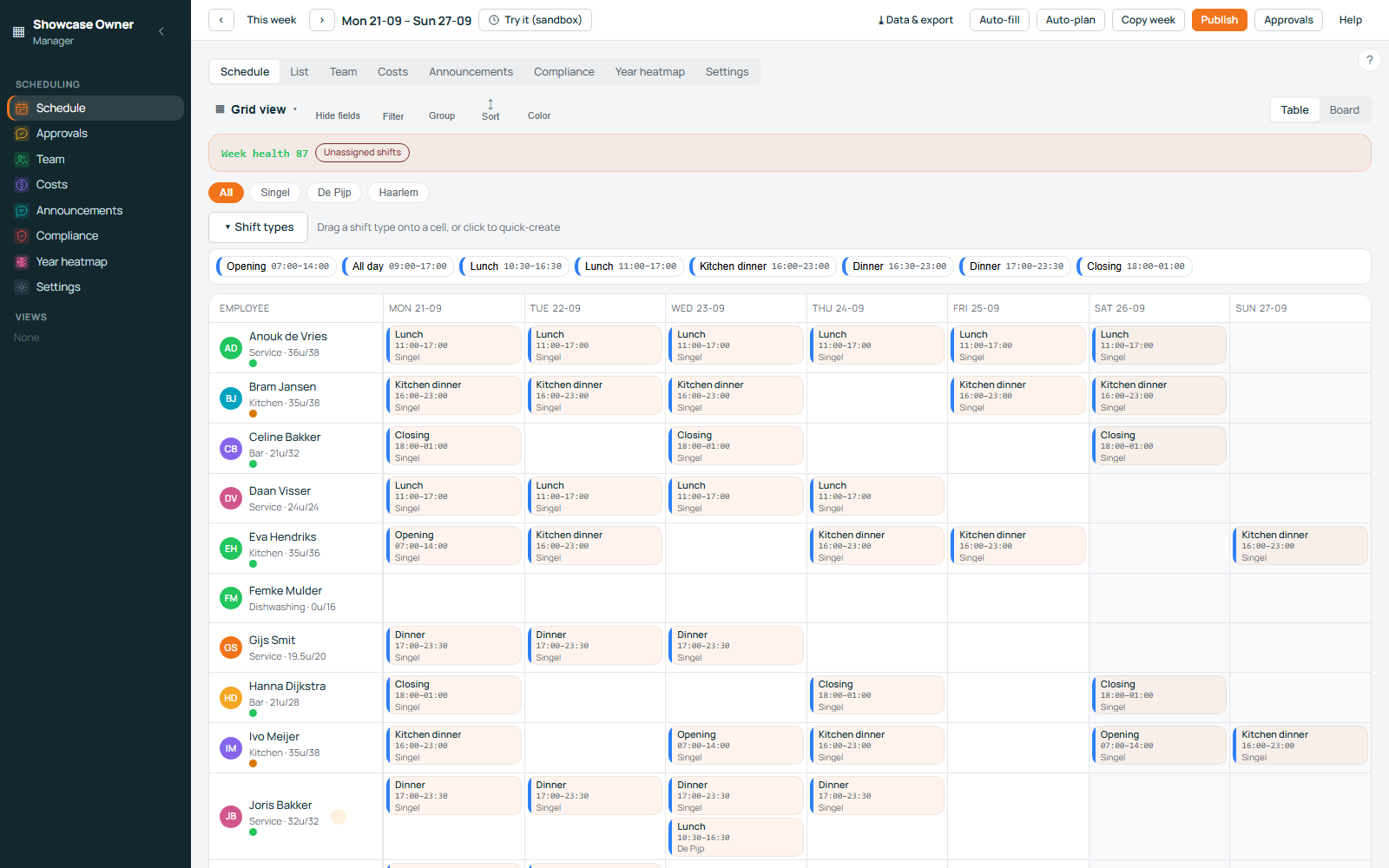
| A weekly rota, built and published | Drag-and-drop grid, templates, a publish that notifies everyone. | Shifts added, edited and published from their app. |
| Availability collected from staff | Three buckets, “available until” times, dated exceptions, mapped onto your shift shapes. | Availability per day, preferences and leave requests, in the app. |
| Swapping shifts | Mutual matching, with a plain-language reason for every refusal. | Staff swap with a colleague; the manager approves. |
| Filling a gap or a sick call | One-tap sick reporting, claimable open shifts, auto-fill that names who it skipped. | Plus temporary workers through Temper and YoungOnes. |
| Clocking worked hours | A button on the employee’s own phone for their assigned shift. | L1NDA Clocker: QR scan with geofencing; their page says it is not standalone. |
| What the week costs | Net hours with Sunday, night and holiday surcharges per calendar day, budgeted per location. | Turnover against labour cost while planning; reports by team, service type, branch. |
| Working-hours rules | Before publishing: rest, day and week length, under-18, contract caps, rule named. | We found no statement about the Arbeidstijdenwet on the pages we read. Ask them. |
| Hours to payroll | Payroll-ready CSV: hours split into regular, Sunday, night, holiday columns. | Live integrations: Nmbrs, Loket.nl, Connexie, AFAS, sdworx, others. |
| Till, kassa or POS | None. No kassa connection, no planning from revenue. | Live integrations: Lightspeed, MplusKASSA, unTill, LEZA and others. |
| An app from the app store | Nothing to install; no store listing for Rosterly. | A native iOS and Android app, in Dutch and English. |
| Languages your staff see | Dutch, English, Polish and Romanian — every person picks their own, and the whole planner is in Dutch. | Dutch and English. |
| Support | Email to the people who build the product. | A Dutch help centre, a weekday phone line, “personal support”. |
| How you start | A workspace you make yourself, no demo or card; optional €195 loading service. | A 14-day trial by request form (phone number asked), or a booked demo. |
| Free band | Free to three active employees; whole product, no trial clock. | No free plan: a 14-day trial, then per scheduled employee. |
| Published price | €3.50 per active employee per month; no minimum, no per-location fee. | €5.20 per scheduled employee, all features included; integrations billed separately, per affiliate, per month. |
Integration names appear because L1NDA publishes them, not because we tested them. Their hub states they partner with more than 50 POS, payroll and hour-registration systems.
What L1NDA does that we do not
Five things, named plainly. If any of them holds your week together, stay put.
Payroll and POS integrations, by name
Their payroll page names Nmbrs, Loket.nl, Connexie, AFAS, sdworx, Easylon and Horecalonen; their POS page names Lightspeed, MplusKASSA, unTill, LEZA and Gastrofix. Hours and contract data move between those systems with nobody retyping them, and with a POS link they show turnover against labour cost as you plan.
We export a payroll-ready CSV and stop there; our product page states there is no till or invoicing integration yet. If your bureau expects a feed, we are on the wrong side of it.
QR clocking with geofencing
L1NDA Clocker clocks staff in and out with a QR scan that only works inside the venue, and the hours land in the same account as the rota. Their page says no extra devices are needed and that Clocker only works alongside L1NDA Planner.
Ours is a button on the employee’s own phone against their assigned shift, shown to the planner as actuals. No scan ritual, no kiosk mode.
A native app in the app stores
Their app is on iOS and Google Play, in Dutch and English, and staff install it for shifts, availability, swaps and leave.
Rosterly has nothing to install: web pages your staff open in the language they pick — Dutch, English, Polish or Romanian — but there is no listing in the app stores and no store push of our own. For a team used to their app, that is a step back in polish even where the planning is equivalent.
A support organisation, in Dutch
A Dutch help centre for contract owners and planners, a weekday phone line, and “personal support” as part of what the rate buys. Their integration pages route you to a team, not a form.
Ours is support@roosterly.pro, answered by the people who build the product. Honest, not equal: if you want to phone someone on a Friday, they are better at it.
A track record in Dutch hospitality
L1NDA says the product was built for hospitality, calls itself “the most used hospitality planning platform”, and publishes case stories about named Dutch businesses — Verhage, Vitaminstore, De Pizzabakkers — some multi-branch and years long.
We have no customers yet: no logo, quote or count on this site, this page included. What we offer instead is a product you inspect before paying, and a free band starting at three people.
The arguments that matter if you run one or two locations
Everything above is what you would give up. These five decide the other direction.
1. The price is charged on a different unit
L1NDA charges per scheduled employee; we charge per counted employee — someone counts only in a month they worked, the two people who worked a single shift are not counted at all, and up to three counted employees the whole product is free. Twelve people scheduled: €62.40 a month against €42.00, or €244.80 a year. At twenty-five: €130.00 against €87.50. Both invoice €0 in a month when nobody is scheduled, so the month that decides it is the quiet one — a winter terrace, students who go home. Our count follows the work; a per-scheduled count does not.
2. Setup is paid in evenings, not in euros
You create a workspace and import staff and rota from CSV, Dutch column headings accepted, with a mapping preview before anything is written — nothing to book, no call, no card. If you would rather not do it alone, €195 buys a session where we load it with you; declining costs nothing.
3. The rules, checked while you plan
Our engine checks rest between shifts (under 8 hours stops; a second sub-11-hour rest in a rolling week is flagged), day and week length, under-18 restrictions, contract caps and fixed-location or days-per-week rules — before publishing, per person, with the rule named. A planning aid, not legal advice. We did not find an equivalent statement from L1NDA on the pages we read, so ask them the direct question rather than assuming either way.
4. The people who staff your weekend
Our staff app is in Dutch, English, Polish and Romanian, and every person picks their own — but it is a web app they add to their home screen, not one they install from a store. A Dutch kitchen or cleaning brigade often includes Polish and Romanian speakers reading a Dutch rota; for them, picking their own language matters more than the app store does. If your team is entirely Dutch-speaking, the store app is still the smoother first day.
5. What happens the day you leave
Both cancel monthly and neither should hold your rota hostage; we export everything — staff, availability, hours, costs — in one action. The real asymmetry is integrations: the more administration runs through connected systems, the more a move costs in workflow, not fees.
Who should not switch
We would rather you stayed than moved for the wrong reason. Do not move if any of these is true.
- Your payroll bureau consumes an L1NDA feed. We hand over a CSV, not a connection, and retyping hours is the cost you wanted removed.
- You plan from revenue. Turnover against labour cost is theirs, not ours, and we have no date for it.
- You need a shift covered from outside your team. The Temper and YoungOnes route fills a gap we cannot.
- Your staff will only use an app they install. Rosterly has no store listing and no store push.
- You need support in Dutch, on the phone. We answer email; they answer the phone.
- You need Dutch payslips out of the tool. We plan and record the hours and hand your payroll office a file; we do not produce payslips.
- You run many branches with a head office. Multi-branch reporting and franchise views are their world, not ours.
- What you have already works. Twenty euros a month is not worth four weeks of retraining.
Be clear about what we are
A planning tool, and nothing more than that
Rosterly plans shifts, records hours worked and estimates what a week costs. It is not a payroll system, not an accounting record and not legal advice: payslips, tax and payroll filings stay with your administration, and we hand over the numbers in a CSV.
The cost figures are estimates for a week not yet worked, and the working-hours checks are a planning aid that names what it looked at — not a professional’s advice.
We have no customers and no press, so judge the product: import a real week and compare it against what you pay for now. Sources were read on 20 September 2026 and both prices can change — check L1NDA’s current pricing and ours on the pricing page before you decide.